

Why I’m Leaving the Well-Trodden Path
The Uncharted Tree

If you have ever dipped your toes into family history, you know the immediate temptation of the modern genealogy database. With a single click, an automated software program will loudly insist on filling your screen with glowing “hints,” tempting you to copy and paste a massive, sprawling forest of hundreds of surnames all at once.
It is easy to get distracted by the sheer volume of names. But if you try to chase every single leaf on every single branch simultaneously, you don’t get history—you get clutter.
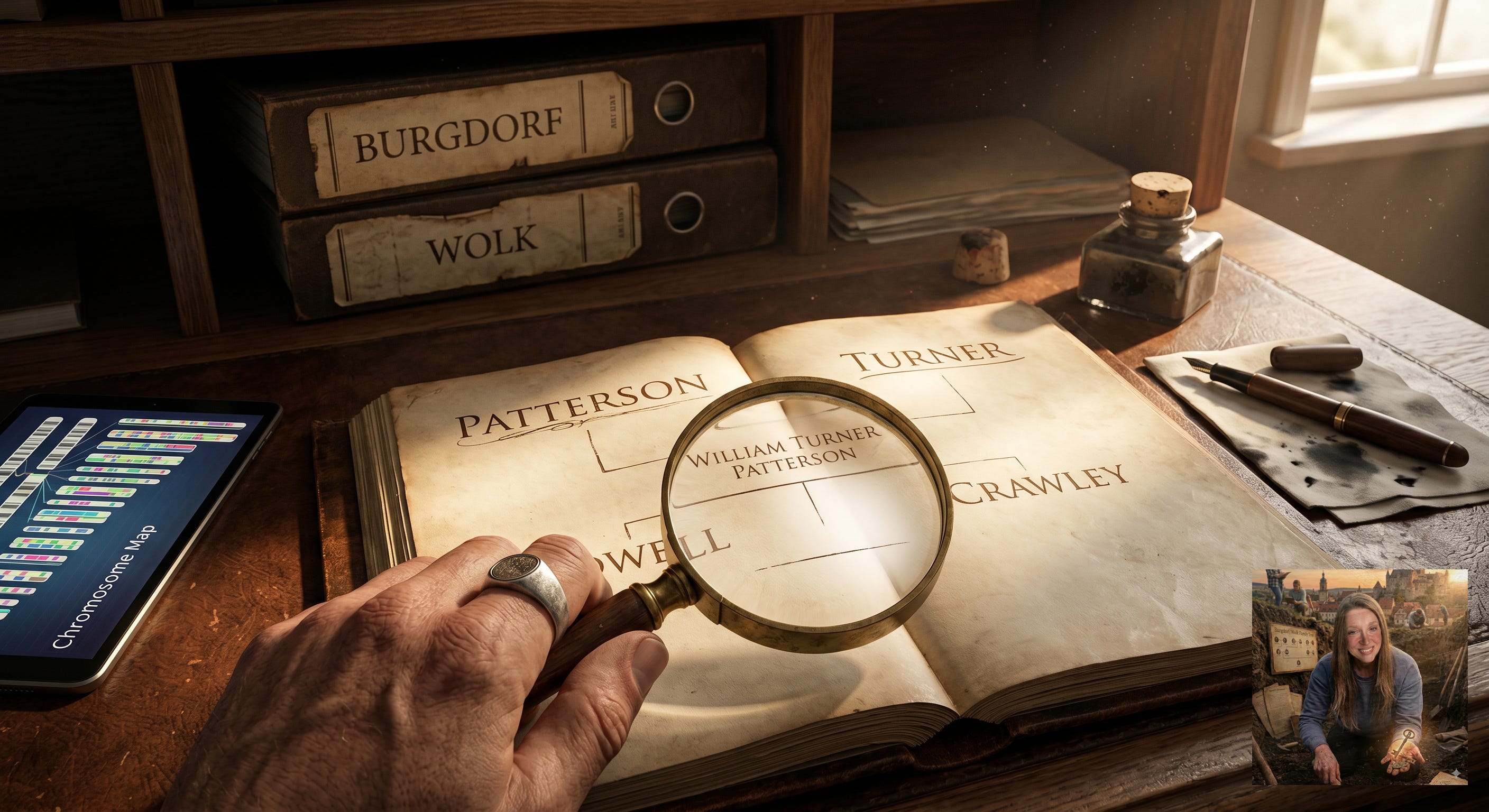
For the past few months, my desk has been covered in records spanning a dozen different branches of our heritage. But as I look at the landscape of our family tree, I am officially clearing the workspace, drawing a strict perimeter, and narrowing my lens to focus strictly on our core foundational bloodlines for now: Patterson, Turner, Powell, and Crawley.
And the reason for this pivot isn’t just about managing the clutter. It’s about going where the real work is left to be done.
The Solved Branches: Honoring the Burgdorf and Wolk Heritage
To understand why I am focusing so intensely on the Pattersons and Powells, you first have to look at the branches I am intentionally stepping away from: the Burgdorf and Wolk lines.
The truth is, we are incredibly fortunate. Through years of meticulous tracking, documentation, and family record-keeping, the Burgdorf and Wolk history has already been heavily, beautifully researched. There is simply nothing more to do there. Their migration paths are mapped, their records are verified, and their places in our history are securely anchored.
Because that side of the family is already standing on such a firm, documented foundation, it frees up my ultimate resource: time. I don’t need to spend hours duplicating work that has already been masterfully completed. Instead, I can take the torch and carry it into the corners of our ancestry that are still waiting in the dark.
Chasing the Uncharted: The Wild Frontier of the Powells and Pattersons
With the Burgdorf and Wolk lines securely locked down, I am turning all of my forensic energy toward the branches that desperately need a dedicated investigator. The remaining lines on my desk aren’t neatly organized in a finished binder; they are sprawling, complex puzzles filled with brick walls, missing census records, and historical anomalies.
By narrowing my focus, the research naturally splits into two deeply fascinating, active investigation zones:
1. The Powell & Crawley Alliance
On one side of the ledger, we are deep in the trenches of the Powell family. But you cannot fully understand the Powells without immediately pulling the Crawley thread. These two lines are completely inseparable in our history, anchored firmly by my great-grandparents Columbus Powell and Allie Luella Crawley.
Their combined records pull our research eyes to locations like Bourbon, Missouri, and eventually forward to the childhood migration records of Florissant. Because this line hasn’t been fully mapped out by generations before us, it requires total, uninterrupted immersion to ensure every single generational bridge we trace is backed by ironclad, primary sources.
2. The Patterson & Turner Pioneer Trail
On the other side of the workspace sits the Patterson line. And just like the Powells, the Pattersons have their own historical counterweight: the Turner line. These two families are bound tightly together in the archives, most notably through ancestors like James W. A. Patterson and Jane Turner, who passed their legacy down to William Turner Patterson.
This branch takes us straight into the heart of the agrarian Boon’s Lick frontier in Howard County, Missouri. As a common surname, the Patterson line is notoriously vulnerable to the “copy-paste trap” of online genealogy. Parallel lines of completely unrelated Pattersons flood the mid-Missouri records. By pairing them directly with the specific Turner records of Howard County, we have the ultimate cross-reference to separate our true Scottish-Virginian pioneers from the digital noise.
Enforcing the Standard
How do you legally prove these uncharted lineages when automated software keeps trying to force wrong matches onto your tree? You look at how their lives ended, you look at their land, and you look at their biology.
To anchor these four lines with absolute certainty, I am spending the coming weeks bypassing casual public trees entirely. Instead, the research is being grounded in the heavy artillery of the Genealogical Proof Standard:
Probate and Estate Records: Tracking court distributions to map the exact legal networks of siblings, spouses, and children.
Original Land Plats: Mapping out physical property boundaries in early Howard County to see exactly who our ancestors lived next to.
Genetic Cluster Tracking: Using modern DNA testing to look at our heritage under a molecular microscope, ensuring our genetic matches perfectly align with the paper trail.
Digging a Deeper Well
The Burgdorf and Wolk archives are safe, preserved, and beautifully complete. They are the bedrock we stand on.
But for the foreseeable future, Sifting Through the Soil is going into the deep, messy trenches of the Patterson/Turner and Powell/Crawley lines. We are going to lock down the primary sources, solidify the DNA matches, and write their narratives with the detail, grit, and accuracy they deserve.
The soil of history is deep—and it’s time to break new ground.