

Don't Click "Merge": A Genealogy Cautionary Tale
Same Name, Wrong Tree

There is a common misconception that genealogy is a passive hobby—a quiet pastime of clicking glowing hints on a screen and allowing an algorithm to effortlessly stitch together the tapestry of your past.
But if you treat family history like a passive collector’s game, you don’t get history. You get fiction.
The reality of historical research is much closer to a forensic investigation. It is a gritty, meticulous process of sifting through centuries of a fragmented paper trail, often for the sole purpose of proving who your ancestors were not. Recently, my research desk became a digital battlefield for one of the most common, deceptively complex surnames in American history: Patterson.
The Siren Song of the Automated Tree
If you have ever dipped your toes into archival research, you know that some surnames are a walk in the park. Rare names leave clear, distinct footprints. But names like Patterson are a sprawling forest.
When the family line arrived in Missouri in the nineteenth century, they weren’t alone. They were stepping into a young, rapidly expanding state where multiple, completely unrelated Patterson clans were settling, sometimes just counties apart.
To an automated software algorithm, a “William Patterson” or a “James Patterson” living in Missouri in 1850 is a blank slate. The computer sees the matching name, notes the approximate birth year, and loudly insists that they must be the same person. It offers an easy button to merge the families. It’s a siren song that has led countless family trees entirely off the rails, creating “phantom lineages” where families from completely different parts of the world are mistakenly glued together by a lazy click.
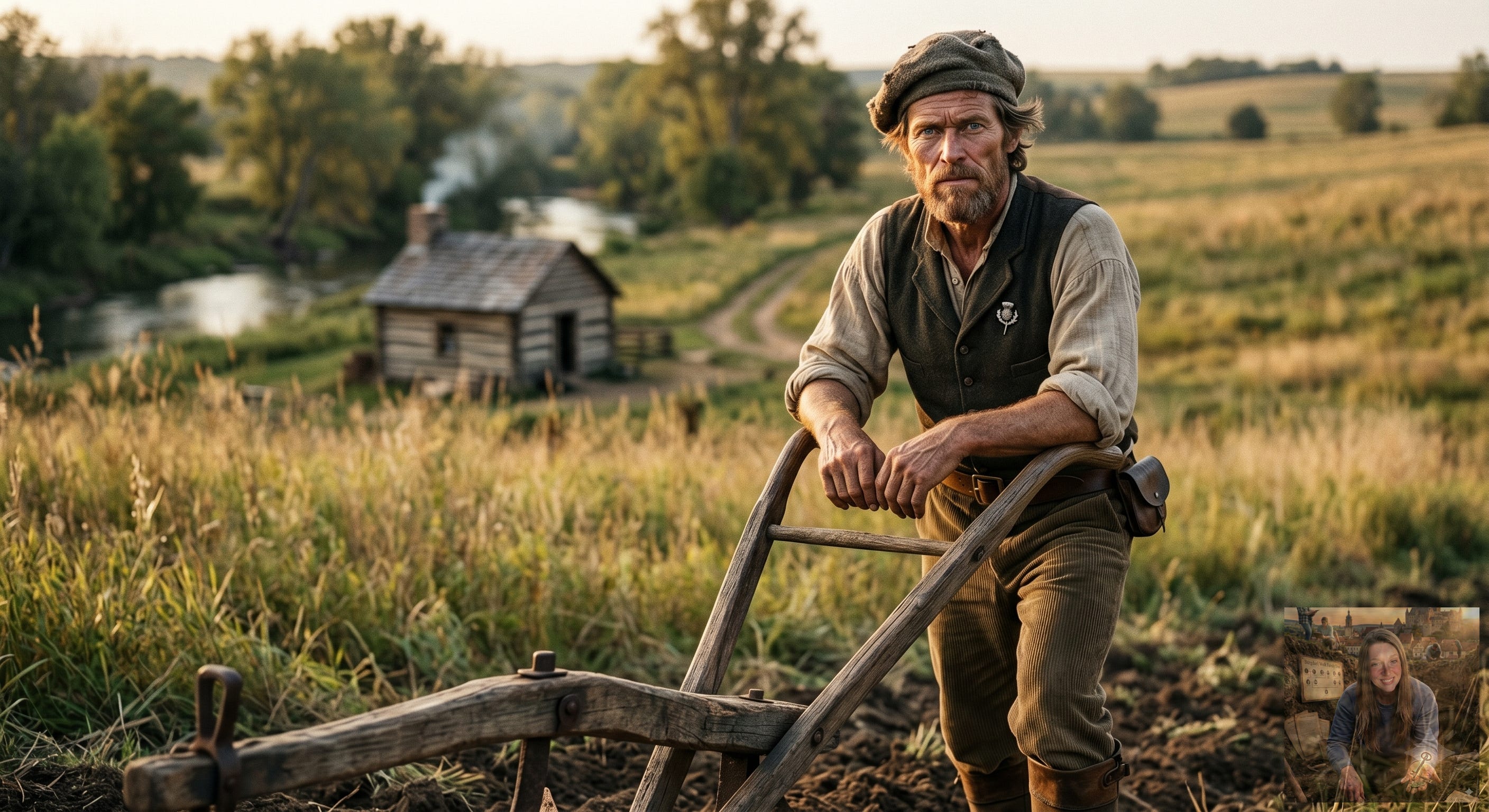
Virginia vs. Pennsylvania: The Great Migration Divide
To build a tree that stands up to scrutiny, you have to look past the first names and map the historical currents. Through careful analysis of primary source documentation, I’ve had to do the heavy lifting to isolate our specific branch from the noise.
In early Missouri, the regional records are heavily saturated by two massive, distinct waves of Patterson migrations:
The Mid-Atlantic Stream: Families originating from Pennsylvania, moving through Ohio or Indiana, and bringing northern farming traditions with them.
The Southern Stream: Families—like ours—with deep roots tracing back to Scotland, who initially crossed into the rugged Virginia frontier before pushing steadily westward into Kentucky and the early settlements of Missouri.
To the untrained eye, the census pages look identical. But the geometry of their lives was entirely different.
[The Missouri Convergence]
   ├── Pennsylvania Stream (Northern Route) ──┐
   │                                          ▼
   │                                   [The Census Maze]
   │                                          ▲
   └── Scotland ➔ Virginia ➔ Kentucky ────────┘ (Our Line)
The Geographic Divide: St. Louis vs. The Boon’s Lick Frontier
As if separating the Virginia migration stream from the Pennsylvania stream wasn’t enough, geography throws another curveball into the mix. In nineteenth- and twentieth-century Missouri, two major, completely distinct hubs for the Patterson surname emerged: one centered in St. Louis County and the other in the historic Boon’s Lick region of Howard County.
To the casual observer scanning a statewide index, it is incredibly tempting to see the same surname across different counties and assume a simple intra-state move. But when you look at the primary documents, you find two entirely different family ecosystems that must be kept strictly separated to maintain historical accuracy.
                [The Missouri Patterson Split]
                              │
         ┌────────────────────┴────────────────────┐
         ▼                                         ▼
  [St. Louis Branch]                       [Howard County Branch]
  • Urban & Suburban Foothold              • Agrarian Boon's Lick Frontier
  • Tied to St. Louis Co. / Florissant     • Deep roots in local plat books
  • Unrelated parallel lineage                 • Anchor for James W. & Gladys K.
1. The Howard County Pattersons: Our Boon’s Lick Pioneers
Further west, along the banks of the Missouri River, lies Howard County—the heart of the historic Boon’s Lick region. This is where our true Patterson roots are anchored.
The Pattersons who settled here belong to a deep chapter of Missouri’s history, arriving as part of the westward pioneer migration. This agrarian branch features ancestors like James W. Patterson, William Turner Patterson, and down the line, Gladys K. Patterson.
Key markers of this line include:
The Agrarian Frontier: They were part of an influx of settlers who cleared timber, established roots, and built lives in a fiercely rural, river-dominated landscape.
Early Plat and Probate Records: Finding these ancestors requires digging into nineteenth-century Howard County plat books and early probate records. Their world was defined by land ownership and early frontier court infrastructure, entirely distinct from the urban development happening back east.
2. The St. Louis County Pattersons: The Parallel Line
Conversely, the St. Louis branch represents a completely different lineage that anchored itself firmly in the communities surrounding the city, particularly in northern county areas like Florissant.
While other parts of our family tree do have connections to the St. Louis area, the Pattersons who lived there are a completely separate entity. Their lives were woven into the rapid growth, industrialization, and mid-century suburban residential development of St. Louis County—a completely different track from our farming ancestors further west.
The Proof is in the Probate
How do you legally separate two families with the same name living in the same era? You look at how their lives ended, and you look at their biology.
To anchor our Scottish-Virginian Patterson line to Howard County with absolute certainty, I’ve bypassed the casual public trees and anchored the research in two unshakeable pillars of evidence:
Probate and Estate Records: While census records only give us a snapshot of a household every ten years, probate courts deal in cold, hard property and legal heirs. By digging into original county estate distributions, you can map the exact networks of siblings, spouses, and children. If a “William Patterson” dies in St. Louis and his estate lists entirely different heirs than our Howard County lineage, the line is successfully isolated.
Genetic Cluster Tracking: Thanks to modern DNA testing, we can look at our heritage under a molecular microscope. By analyzing our genetic matches and separating them into distinct clusters, the data clearly aligns us with the Southern/Virginian migration stream that settled the Boon’s Lick. The DNA confirms the paper trail, cutting right through the geographical confusion.
Why We Sift
It takes a human eye to look at an archival record, question the automated assumptions, and enforce the Genealogical Proof Standard.
We don’t do this work just to fill blanks on a pedigree chart or boast about a long list of names. We do it to rescue real people from being erased by historical clutter. By rigorously defending the facts of our Howard County Patterson line, we ensure that when we tell the stories of their journey from the lochs of Scotland to the valleys of Missouri, we are telling the truth.
The soil of history is deep, and it is messy—but the truth is always worth the dig.
🕵️♀️ From the Archives
I am currently fine-tuning our Patterson lineage tracking spreadsheet, double-checking every single land and probate bridge to ensure the integrity of the line. If you are an archivist, a cousin, or a fellow researcher working on the Southern Patterson migration stream into Howard County, I’d love to hear your thoughts in the comments below!